
Third-Party Marketplaces After Trade Hold: How the CS2 Economy Evolved
NOVEMBER 10, 2025
#Trends 2 min read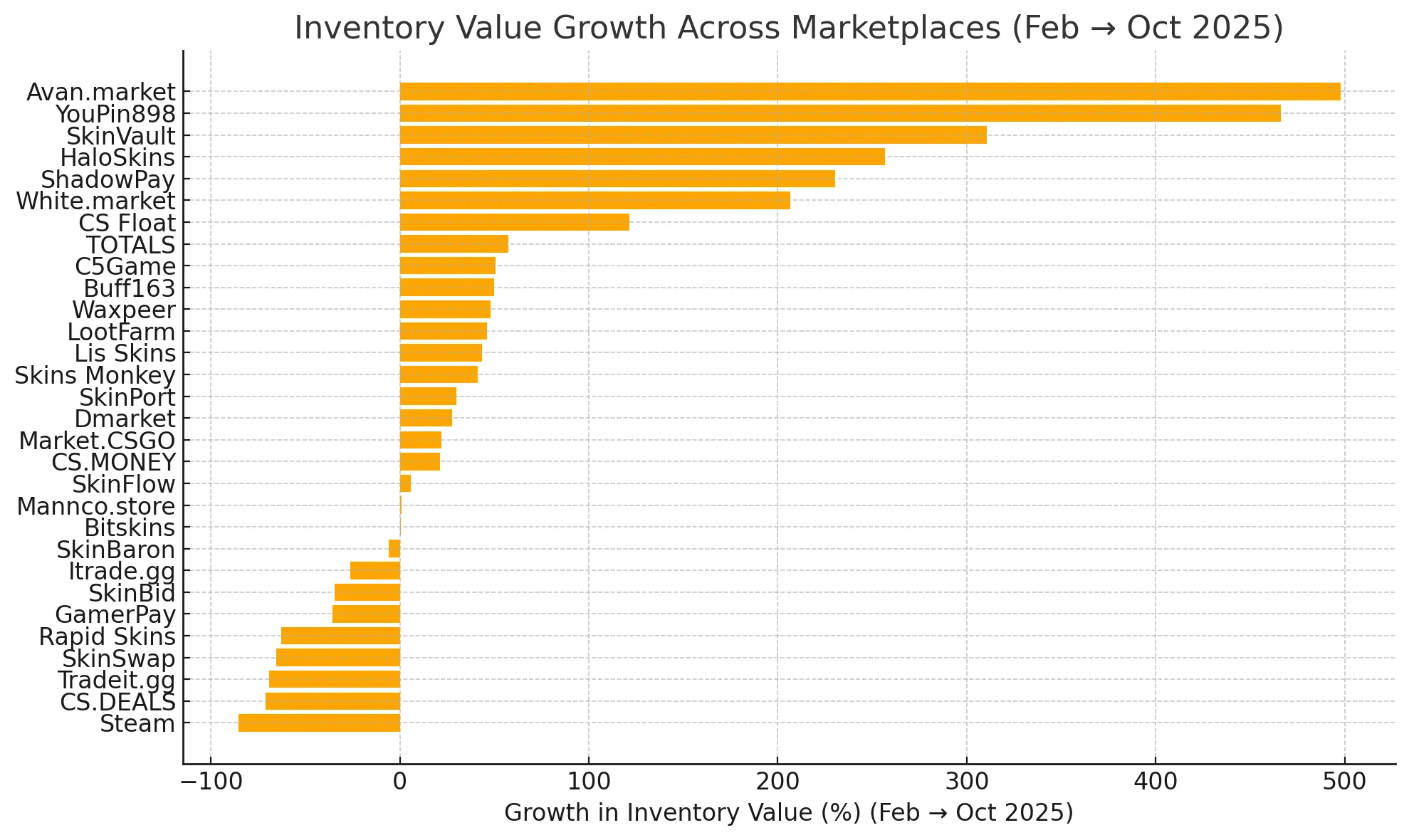

Massimo Formby — Market Analyst
By: Massimo Formby - Market Analyst
To see how the market has stabilised since, I have looked at data from 29 marketplaces between February and September/October 2025.
While there are more than 60 active sites globally, this sample covers the ones with available public data on user engagement and listed inventory value.
High-Level Market Summary (Feb > Oct 2025)
1. Engaged Users
Average per marketplace: - 2.1M → 2.8M (+33.4%)
Total (sample of 29): - 61.6M → 83.8M (+36%)
2. Listed Inventory Value
Average per marketplace: - $8.9M → $10.7M (+20.2%)
Total (sample): - $257M → $309M (+20%)
Even after the Trade Hold, user engagement and item value increased across nearly every major platform. The market hasn't died, it's consolidating.
These figures don't represent all Counter-Strike marketplaces just the 29 most measurable ones.
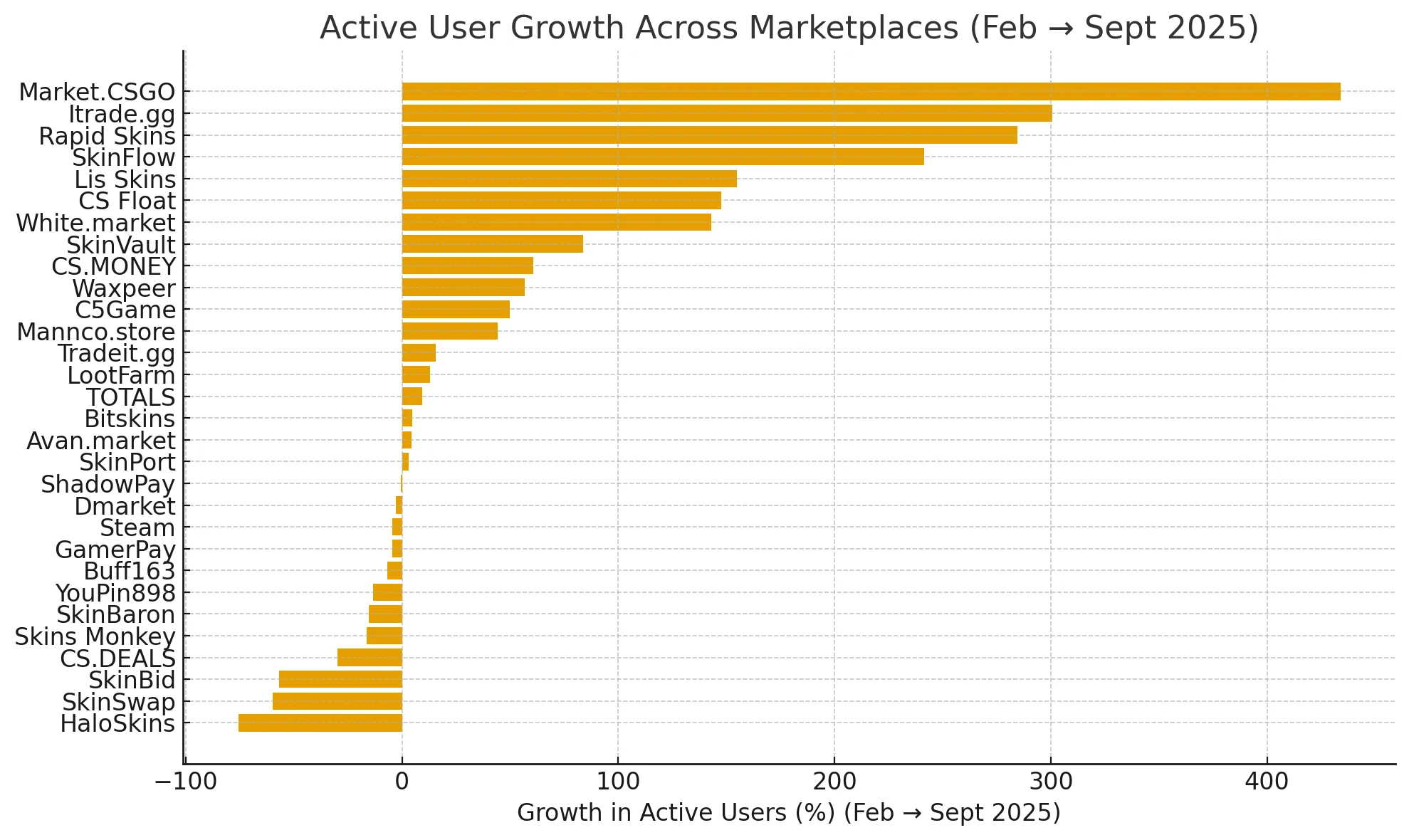
Top Marketplaces by Engaged User Growth (Feb > Sept)
- Market.CSGO: +433.9%
- Itrade.gg: +300.8%
- Rapid Skins: +284.5%
- SkinFlow: +241.3%
- Lis Skins: +154.9%
- CS Float: +147.7%
- White.market: +143.1%
Top Marketplaces by Inventory Value Growth (Feb > Oct)
- Avan.market: +497.7%
- Youpin898: +466.3%
- SkinVault: +310.6%
- HaloSkins: +256.6%
- ShadowPay: +230.2%
- White.market: +206.7%
- CS Float: +121.4%
Decliners and Stagnant Markets
Several marketplaces saw double-digit drops in both users and listed value, largely due to regional restrictions and inconsistent withdrawal reliability. Sites that leaned on bot farming or inflated "daily active users" have been hollowed out. Many are now effectively catalogues rather than functioning exchanges.
Conclusion
The Counter-Strike 2 economy has proven remarkably resilient following the Trade Hold update. While many predicted the collapse of third-party marketplaces, the data shows a different story: market consolidation and growth among trusted platforms. The traders who adapted quickly and leveraged tools like SkinScanner to compare prices across multiple marketplaces have been able to navigate these changes successfully. As the ecosystem continues to mature, understanding which platforms are growing and which are declining becomes increasingly crucial for making informed trading decisions.